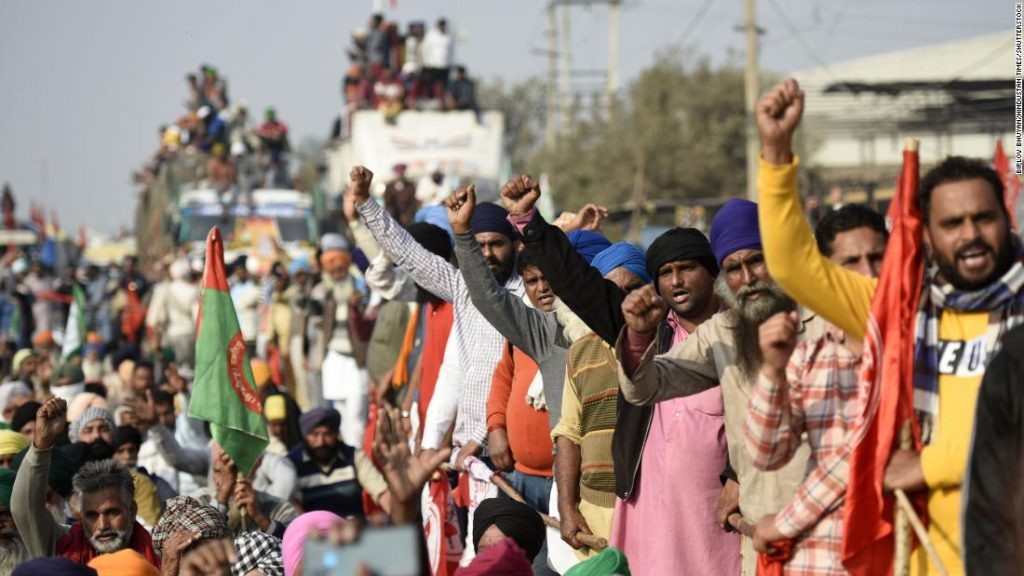
“But you can see today that we are getting support from across the country, which is proving this is a pan-India movement from Kashmir to Kanyakumari and from Assam to Gujarat,” he told Al Jazeera.
A 50-year-old woman from Punjab state’s Patiala, who has been protesting at Singhu for the last 10 months, told Al Jazeera “we are mothers, wives and daughters of farmers” and that they “are not going anywhere” until the laws are withdrawn.
“The government has not been listening to us so we have been sitting here on the roads,” she said. “If farmers stop working, where will you get your food from? The entire country will be without food. The farmers have not been getting their due rates.”
Kohar said Monday’s protests enjoy popular support even in the states governed by Modi’s Bharatiya Janata Party (BJP), including Haryana, Uttar Pradesh and Karnataka.
Earlier this month, more than 500,000 farmers attended a rally in the most populous state of Uttar Pradesh, the biggest yet in the protest campaign.
Farmer union leaders earlier on Monday said their protests would not disrupt emergency services. “We will also make sure that the strike remains peaceful,” Tikait said.
But long traffic jams were reported at many highways leading to New Delhi.
Gurpreet Singh, a 30-year-old businessman in the city, said he was stuck at the Delhi-Haryana border while travelling for work.
“I am with the farmers. I am completely fine if I am facing a difficulty today. I will choose a different road (to travel),” he told Al Jazeera.
“People are facing difficulties because of the strike but I am not angry with the farmers. It is for the larger cause. People should cooperate.”
The protests have been generally peaceful but police and farmers clashed in New Delhi in January during a tractor procession and one protester was killed and more than 80 police were injured.
Farming sustains almost half of India’s more than 1.3 billion people and accounts for about 15 percent of the $2.7 trillion economy.
Source: aljazeera.com/news/2021/9/27/nationwide-strike-by-india-farmers-a-year-after-farm-laws-enacted

 Previous Post
 Next Post